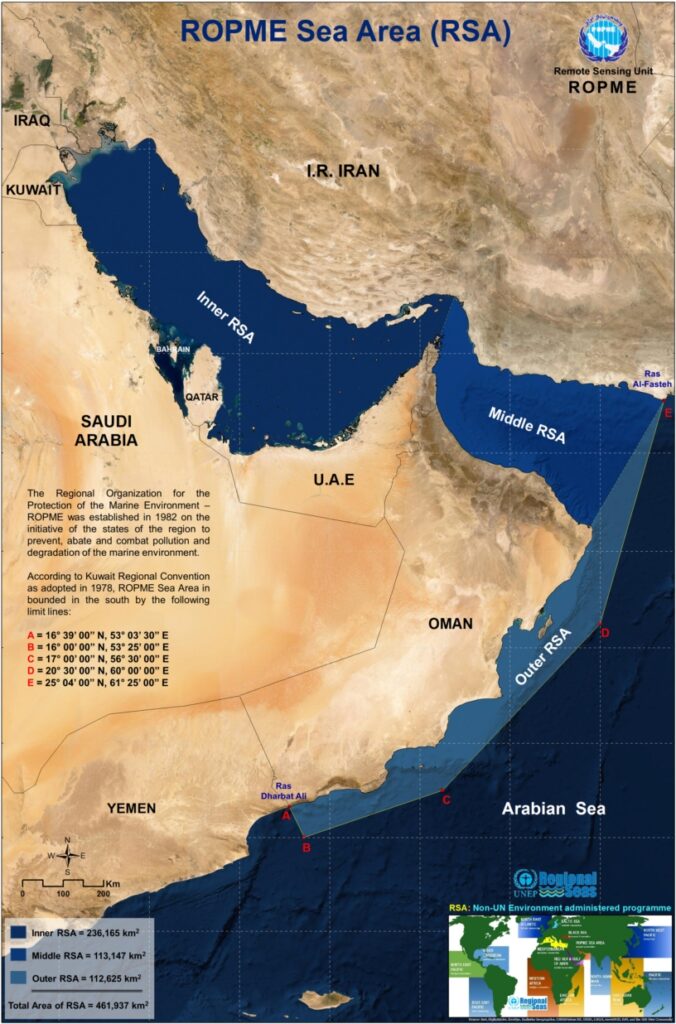
Background
The ROPME Sea Area (RSA) is a shared environmental and economic lifeline for eight Member States: Bahrain, I.R. Iran, Iraq, Kuwait, Oman, Qatar, Saudi Arabia, and the United Arab Emirates. Following the adoption of the Kuwait Regional Convention and Action Plan in 1978, ROPME was established to address cross-border marine threats through regional cooperation.
The eight coastal States of the Region have long recognized the vital necessity of coordinated action to protect the semi-enclosed sea they share. This concern led Kuwait, in 1973, to propose to the United Nations Environment Programme (UNEP) the hosting of an intergovernmental meeting to address marine pollution. In 1974, during the Second Session of the UNEP Governing Council, the participating States requested UNEP’s involvement in developing a regional environmental programme.
In 1976, the UNEP Governing Council authorized Kuwait to proceed with the necessary preparations. That same year, a UN inter-agency mission visited all eight States to collect scientific and socio-economic data, which led to the formulation of a preliminary Action Plan. Consultations and legal drafting followed in Geneva, Nairobi, and the Region, with key contributions from experts and UN agencies.
By June 1977, final drafts of the Action Plan, a regional Convention, and a Protocol on pollution emergencies were completed. These were presented to the Regional Conference of Plenipotentiaries convened in Kuwait from 15–23 April 1978. On 23 April, the conference adopted:
- The Action Plan for the Protection and Development of the Marine Environment and Coastal Areas
- The Kuwait Regional Convention for Co-operation on the Protection of the Marine Environment from Pollution
- The Protocol concerning Regional Co-operation in Combating Pollution by Oil and Other Harmful Substances in Cases of Emergency
This milestone established the legal and institutional framework for what would become ROPME — the Regional Organization for the Protection of the Marine Environment — a model for regional environmental governance in semi-enclosed seas. Since its establishment, ROPME has provided technical coordination to the Kuwait Action Plan (KAP) and assisted its eight Member States in the implementation of the Convention and its Protocols, as well as a number of projects, covering environmental assessment and environmental management, including public awareness and training. ROPME Sea Area (referred to as the Kuwait Action Plan Region in the past) is the sea area surrounded by the eight Member States of ROPME: Bahrain, I.R. Iran, Iraq, Kuwait, Oman, Qatar, Saudi Arabia and the United Arab Emirates. The term “ROPME Sea Area” was coined by Plenipotentiaries of the Member States to achieve unanimity in denoting the area covered by the Kuwait Regional Convention of 1978. It in fact reflects the goodwill of the Member States to cooperate in protecting their common marine environment in spite of the existing geopolitical boundaries. According to Article II of the Kuwait Regional Convention, the ROPME Sea Area (RSA) is defined as extending between the following geographic latitudes and longitudes, respectively: 16°39’N, 53°3’30”E; 16°00’N, 53°25’E; 17°00’N, 56°30’E; 20°30’N, 60°00’E; 25°04’N, 61°25’E.
Today, ROPME continues to coordinate the region’s efforts through five thematic pillars:
- Biodiversity: Coral reefs, seagrass, mangroves, marine turtles, and dugongs
- Hazardous Substances: Oil spills, chemicals, and marine debris
- Eutrophication: Nutrient loading and harmful algal bloom monitoring
- Maritime Pressures: Ballast water, port waste, and heavy shipping lanes
- Environment Fact Sheets: Science-based reporting and indicators